Friday, June 30, 2017

Exchange Students: Get the Most Out Of Your Year Abroad

1.    Sort out the essentials before arriving.
This may not sound like the most exciting advice in the world, but that makes our first piece of advice any less important. Before arriving in a new country make you know exactly where you will be living and how to get there. There are few experiences, more stressful than arriving in a new country and not having any idea where you are going with a few suitcases weighing you down in the process. This is even more vital is you’re doing your exchange in a country in which you don’t speak the language fluently. So before leaving home to make sure you have the address written down and have details notes on how the local bus or train system will get you there. The third major thing to remember is to make sure your mobile phone and sim card will be useable. This can be useful for Google maps and simply telling your family you arrived in one piece. Finally, speak to your bank in your home country to make sure your card will be usable is your new destination. Even with this knowledge telling the bank you are moving abroad for a year can save a lot of hassle. It is totally normal for banks to freeze accounts if there is some unusual activity on an account. In other words, without informing the bank it may only be a matter of time before your supply of money is blocked, a situation in which everybody would want to avoid.

2.    Get the balance between meeting local and fellow exchange students right.
One of the most enjoyable and important parts of studying abroad is to meet people who like you (or at least we hope) who are also interested in learning new languages and about new cultures from all around the world. The experience can open your mind up in so many ways of thinking as you come into contact with so many types of people you would never have met before. You will make some great friends. Some will last a few months, others a lifetime. Exchange students are the easiest to meet as everybody is in the same boat as you. They arrive knowing a few people and often nobody. Like you, they are desperate to start building a social circle and regaining a sense of normality and structure in their lives. They are also the group of people who will have more free time than others and for the most part, will do all they can to enjoy the free time. We are not saying that is a bad thing. You just simply must find a balance between the two. As a native English speaker, it is very easy to fall into the trap of spending all your time with other exchange students and never practising your language skills. While local students are more difficult to get to know they will really help make your experience worthwhile. As an exchange student, you can spend so much time learning about other cultures far away you don’t really consume the one you are surrounded in, in the very moment. This is the quickest way to improve your language skills and who knows you may just do enough to encourage your new best local friend to do the exchange in your city.

3.    Choose your friends wisely and in small numbers.
No, I am not suggesting you make five friends on the first day and not bother to meet anybody else. In fact, I am saying the opposite. For the first few months go to as many social events as possible. Meet as many people as you can and give every new person a chance. But as you move further and further into your time abroad and in turn move closer to coming to when you will go home again, start to identify the people you have connected the best with. Start spending more and more time with them. Again, this does not mean you ignore everybody else. It just means be realistic. Despite best intentions, it will be impossible to keep in contact with all the friends you make while abroad. The best evidence of this is that you will soon realise how difficult it is to keep up with all your friends back home while abroad. But unlike your friends at home, you won’t be returning to all your new international friends after 12 months. In truth, many you will most likely not see again sadly. So, the further time goes on, in your mind choose who of these new friends you want and realistically feel you will be able to keep in contact with and focus on them. This is the best way to keep your experience going long after you come home.

4.    Be/Find Yourself
Whether you are at home or abroad the hope must be, that one can be themselves and that we surround ourselves with friends who know who are we are and accept and like us for who are we are. The trouble is we often lose our edge as people in order to fit it and maintain and create new friendships. At home, the world is a smaller and more permanent place. So, we hide our true selves to a point. Most often it is something small like “that music group you secretly love but would never admit to” When socialising with exchange groups there is an automatic acceptance they people are different to ourselves simply because they are from somewhere different to ourselves. This setting gives you as an exchange student a great opportunity to let down any walls that may be standing. The experience will teach you to be more honest with yourself and others and overall a happier person. The key is, to realise you can do the exact same back home even if it a little bit more difficult to do so.

5.    Don’t live with people you know from home
If I was to take this advice further I would say “Do your year abroad alone” While often this is can be seen as a step too far and often simply impossible to do depending on your program. To get the best out of your year abroad you really should not spend much people time with people from your home country. This is simply because you will be far less likely to experience new things. Again, this is unrealistic. It is easy to get homesick while abroad and spending time with friends from your country or city can make that a lot easier. But a line must be drawn somewhere, otherwise, you are defeating the purpose of going abroad. If you think going abroad for a year with your five best friends and doing everything together is going to help you really embrace a new culture think again. All you are doing is wasting your money as in reality you’re not going to do anything you would or could not do at home. Whether it is living, working, studying or partying with people from other nationalities don’t let the fact you have friends from home stop you from people many new people as possible. If you have open minded friends from home they will want to do the same and you won’t waste the year in any way.

6.    Travel, Travel, Travel
This can somewhat depend on where you are coming from and where you are doing your exchange. As somebody living in Ireland away from mainland Europe, living in Germany and suddenly having the ability to visit so many new places without having to fly is quite amazing. If you are an exchange student no matter where you go on your exchange you will most likely suddenly living next many amazing places that only a few days earlier were so far away. Take advantage of this and see as much as you can. Since you will be in your new city for at least a few months it may be good to invest in some way of getting around cheaply like a bus pass. This will further help you see how small the world truly is. You will have a lot of fun and if you book things in advance, travel can be done cheaply.

7.    Study Something New 
Sadly many degrees are quite restricted. Once you have picked your major, degrees and career paths can quickly become very tunnel visioned. This is why in particular studying abroad is great. It gives you a chance to study something new and potentially discover new talents and interests. Even if you are under strict rules on what you can and cannot study, seeing your studies from a different perspective can be very insightful and rewarding. Especially in business, history and social sciences where views and perspectives can differ greatly from country to country. You will return home a much more rounded student. So my advice is to study something new and just see where it takes you. It may be the last time you have a genuine choice is what you study.


Did I leave something out? If so leave it in the comments below 

Saturday, April 8, 2017

22 Habits To Help You Be Happy

When I wrote my initial blog about the period of depression I went through, I promised I would write a follow-up piece on how I eventually got passed it. A year on it is almost hard to remember how difficult those 6 months were.  In other ways, it’s not difficult at all. So if anybody would like to read that post for the first time or again, you can find it here. 

I have found people usually become depressed for the following reasons:
1)    Not feeling connected to others
2)    Feeling underappreciated
3)    Lack of direction
4)    Abuse or a major social/personal loss

So here are 22 ways of thinking/things you can do that I eventually stumbled upon, one by one by taking to people, reading, listening and finally learning a few lessons the hard way. I don’t claim to be a professional on this stuff but sometimes experience is the best teacher.

1.    Contrary to popular belief it is a good thing to compare yourself to other people. When you look at people who are ahead of you, it can work as a motivation to work harder and to better yourself. While seeing people who are less fortunate than you can help you feel grateful for what we do have. But either way at the end of the day the only person you need to compare yourself with is the person you were yesterday. You define your own success.

2.    As already mentioned, be grateful for what you do have. The fact you can read this means you have an internet connection and electricity. That’s a lot more than many others. You also most likely have something to eat and somewhere to sleep. Again much more than many. Let that sink in.

3.    Take appreciation from the interactions you have with others. Often when we feel lonely it is not because we are alone. We have people in our lives. You simply are not taking satisfaction from those interactions. When you are finished an interaction with anybody take a moment just to reflect on it and appreciate the fact it was possible to spend time with kind and friendly people. If you can’t find satisfaction from these interactions maybe it is time to find a new peer group.

4.    When I was in in H&M the other day I saw a sign which said “If it makes you happy, wear it” And it is so true. Be honest with yourself and others about what you like and what you don’t. Be proud of that band or whatever it is you love. Even if you know full well 90% of your peer group might not feel the same way. No two people are the same. Our interest play a big role in that. Be proud.

5.    Take a few personality tests. For example "16 Personalties” It is easier to make social, career, and family choices when you have a better understanding of what type of person you are.

6.    Accept nothing is permanent. Most people lose a best friend along the way. Most first relationships fail. Most people lose a job at some point. Our circumstances and people can change in an instant. Holding onto the idea of what was will only bring you pain. As Budda once said, “When you let go, you create space for better things to enter your life.”

7.    A simple one, but maybe the hardest. When you are having a rough period tell somebody. Don’t be afraid to reach out.

8.    You need to set yourself daily, weekly and monthly goals. Goals give every day a reason and every reason gives you something to work towards. There are few things worse for one's self-esteem than sitting around and not doing anything to improve oneself or the world.

9.    Start categorizing the people in your life into groups and don’t be afraid to move people between categories. For example, best friends, people you want to get to know better, old friends you love but don’t see as much as you like and the good people you see every day and you want to focus on.

When you accept what role somebody can play in your life at the moment, you will be a lot less likely to become upset when they are not there for you as much as they once were. If you move to a new town or your friend gets a new job with a heavier workload you need to accept where the two of you are right now. The strengths of friendships fluctuate as time goes by and that is simply part of the ride. Like you they have their goals and ambitions. Mind you a real friend will do all they can for you if disaster strikes. Eve from the other side of the world.

10.    Take a genuine interest in others. Make sure they know you are really listening to them. It makes the other person feel appreciated and they will take that same interest in you. It leads to all round better communication and relationships.

11.    Never get into a routine that doesn't allow you to let your hair down and so something spontaneous sometimes. Have a plan, be organised but planning every minute of your day will make it hard to really enjoy anything and live in the moment.

12.    Make time for hobbies you are really passionate about. It will help you to be more engaged, happy and fulfilled in everything you do. It can’t be all work.

13.    Find time to be kind to people and animals. Especially those who are less fortunate than you. He who gives always gets more out of giving than the person receiving. The other people will be helped and you will feel better about yourself.

14.    Try and distinguish between the things, tasks and people that make you uncomfortable. Some will make you uncomfortable as deep down you know it is something that will make you a better version of yourself. While other things will make you uncomfortable as they are just morally wrong. Spot that different.

15.    Learn how to spend time alone quietly to be with your thoughts. If you can do it in nature. Even better. It is the best way to really find out how we are doing. It is a way of checking up on ourselves.

16.    Make time to read or listen to a philosopher or an inspiring leader. Nelson Mandela, Tony Robbins, Pluto, Socrates etc. You get the idea. These moments often just put what is going on in your life at the time into perspective.

17.    Let the past go and try not to worry about the future. Live in the moment and be present with the people you are with at the time. In other words put that phone away.

18.    Remember worrying only increases the size of the problem. Worrying is not a solution.

19.    Remember when one door opens another 10 open.

20.    Try and be a person the 15-year-old version of yourself who dreamed he/she could be/do anything would be proud of. The longest relationship you will have is with yourself, making it the most important. Make yourself proud.

21.    Forgive those who have wronged you. Holding on only prolongs the suffering.

22.    Get your 7-8 hours sleep a night and do your best not to eat too many sugars.


In a nutshell. In order to be happy:

Know who you are and be unapologetic for it. Find what you are passionate about and embrace it. Be kind to others but look after yourself first. You are no good to others despite good intentions if you are secretly miserable. Find people who make you happy. Remember nothing is permanent. When something is wrong don’t be afraid to speak out. Finally, have a positive attitude and keep the belief and hope you can achieve all your hopes and dreams.


Some quotes about happiness to finish:

Mark Twain: The best way to cheer yourself up is to cheer somebody else up.

Budda: No one saves us but ourselves. No one can and no one may. We ourselves must walk the path.

Mahatma Gandhi: Happiness is when what you think, what you and what you do are in harmony.

Steve Maraboli: If you want to find happiness, find gratitude.

John Lennon: When I was 5 years old, my mother always told me that happiness was the key to life. When I went to school, they asked me what I wanted to be when I grew up. ... They told me I didn't understand the assignment, and I told them they didn't understand life.

Tony Robbins: "Progress = happiness"

Chinese Proverb:
“If you want happiness for an hour — take a nap.’
If you want happiness for a day — go fishing.
If you want happiness for a year — inherit a fortune.
If you want happiness for a lifetime — help someone else.”
Chinese Proverb

Franklin D. Roosevelt: “Happiness is not in the mere possession of money; it lies in the joy of achievement, in the thrill of creative effort.”

Seneca: “For many men, the acquisition of wealth does not end their troubles, it only changes them.”

Stacey Charter: “Don’t rely on someone else for your happiness and self-worth. Only you can be responsible for that. If you can’t love and respect yourself – no one else will be able to make that happen. Accept who you are – completely; the good and the bad – and make changes as YOU see fit – not because you think someone else wants you to be different.”


Oscar Wilde: “Some cause happiness wherever they go; others whenever they go”


Dalai Lama: “Happiness is not something ready-made. It comes from your own actions.”

Helen Keller: “When one door of happiness closes, another opens, but often we look so long at the closed door that we do not see the one that has been opened for us.”

Thursday, December 22, 2016

55 things I’ve taken from four months of living in Germany

I've decided to change it up for November and December. Instead of writing about all the experiences I have had, I will write about everything I have learned. Christmas and the New Year period are always a nice time for reflection. 

Friendship back home

  1. It goes without saying you will drift from many of your friends back home simply because you are not seeing them very often. It will hurt and there will times when you doubt certain friendships. But you have to remember that people are busy, you’re busy settling into your new life and more often than not the temporal drifting is only natural and to be expected. The friends who do care will show it and with this change, that famous Bob Marley quote “everybody is going to hurt you. You just gotta find the ones worth suffering for” comes to mind.
  2. The quickest way to find out if you have a real friend or a convenience friend is to spend some time apart.
  3. You will miss your friends and family so much. You realise how much many of them mean to you.
  4. Introducing friends from your year abroad to friends back home is even more enjoyable and fascinating experience than interesting school friends to University friends and vice versa.
  5. Meeting up with your best friends again can exceed all expectations. The fact friendships can restart like you were never gone is a great feeling.
  6. It is impossible to see every friend you want to see if you’re only home for a few days or even weeks.


When abroad

  1. You become incredibly proud of where you are from. What makes your country unique will more likely never feel more important to you. Even if you don’t always express it.
  2. You constantly compare everything abroad to what it is back home. From shops, people, lifestyle, architecture, food and so much more. It never stops.
  3. If you are ever having a bad moment you immediately build up an unrealistic and utopian version of life back home in your head.
  4. You realise you don’t need as many things to be happy. You just need a bed, food, water and most importantly good friends. Ok, I’ll admit you need a fast internet connection but the point is still valid.
  5. The sense of freedom is breathtaking. 


Language
  1. While speaking the local language is a great help. The abilities to be kind, humble, respect other people’s struggles and to take a genuine interest in them will make you friends a lot quicker and get you a lot further in general.
  2. Just because you understood a word in a new language last week, does not guarantee you will remember it today.
  3. If you can do something you’re generally nervous about (for example asking a question in class) in a foreign language you quickly realise the fact you were ever nervous about it in your mother tongue was a little silly.  
  4. At times you get sick of speaking a foreign language but if you don’t speak it for a while you actually miss it. Or maybe you just feel guilty????
  5. You do have a different personality depending on what language you are speaking.


People
  1. No matter where you are or where people are from. With any group of people, you will always find people you really like and others you simply can’t stand.


Friends when abroad

  1. You’re far more likely to make friends with other foreign students than you are with locals. In fact, unless they go out of their way to meet foreign students or have experienced been a foreign student themselves you won’t become friends with local students.
  2. As exciting as it is to meet people from all over the world, foreign/exchange/Erasmus students will naturally spend more and more time with their own nationality or nationalities they are a little more familiar with. Often without realising it.
  3. A person’s character, personality and interests are far more important than where they are from but if you want to learn about other cultures make sure you get to know people who are from complete other parts of the world. It is here where ideas, cultures and beliefs collide These ideas often challenge your own and it is truly an eye-opening experience.
  4. Knowing you have friends and will continue to have friends from all around the world is a very comforting and inspiring realisation.
  5. The friends you make from different countries will have a greater effect on how you see that country than their politicians ever could or will. 


Coming Home

  1. It will take you longer to settle back home after time aboard than it took you to settle into a new city abroad. This is because a part of you expects things to be the exact same as to when you left, while when you go abroad you probably had no idea what to expect and there are no expectations to shake off.
  2. You can spot people (even strangers)  who have lived abroad and those you have not by their immediate reaction when you tell them that you are doing just that.
  3. You think everybody should live abroad or at least live in a different part of the country.
  4. You get angry and frustrated when people don’t see the value of living aboard.
  5. Maybe for the first time ever you realise how strong of accents all your friends and family members have.
  6. Even if you love home the thought of living in your home town or city for the rest of your life is the most scary thought imaginable.
  7. The fact you can speak you first language all the time seems too easy and no matter what you are doing you feel a little lazy.


Life Lessons

  1. The person you are abroad is more the person you want to be, than the person you are at home. That is simply because you can be whoever you want to be because nobody has a judgement about you. Also new people can’t judge you based on who you are friends with. You learn who the real you is and you can express that.
  2. You can be your true self no matter what country you live in. But god dammit it’s harder at home. But it is important to do just that.  
  3. It is better to go somewhere once than to read about it a thousand times.
  4. Maybe this is one that applies to me in particular. As a guy you can hug your male friends, tell them you love them, send them “xxxxxx” in a text and it does not have to be weird in the slightest way. The whole kissing each other on the check thing as a greeting. Ill admit I’m not there yet but I'v come a long way in a short space of time. Baby steps. 
  5. The world is a very small place. The only trouble is plane tickets to visit friends are often very expensive.
  6. The quickest way to find out if you have a real friend or a convenience friend is to spend some time apart.
  7. Do your best to be in the moment and to be present with the people you are with. For example when at home don’t be texting your new friends from your year abroad when with your friends from home and vice versa. You can do that when you get home.
  8. Live in the moment.
  9. Been an introvert and living in student dorms can be both the best and worst thing that has ever happened to you.
  10. Cooking together is a great bonding experience.
  11. Change is hard but enjoying and most importantly so so worth it.
  12. A night in talking about politics, relationships, sport, music or whatever topics are important to you will always beat a night out. Especially when it is cold. 
  13. When you do something you are truly and genuinely passionate about. The people around you will sense that and champion you along, even if they don't understand entirely why it means so much to you. 
  14. The importance of letting go of the negatives back home and that it is so much easier to do that when abroad.  


Every day lessons about living in Germany (Survival guide)

  1. If you are willing to get public transport at the most awkward times imaginable you can travel around Europe very cheaply and effectively. Even as a student. Flixbus will be your best friend
  2. While the transport system is very good. It is nowhere near perfect, trains are often late. All be a few minutes usually. 
  3. More experiences > Less but more expensive experiences.  
  4. 99% of the time you could get away with not paying for the U- Bahn but it is simply not worth the risk because of fines.
  5. If you get a drink of any sort at the Christmas markets don’t be surprised if you are charged up to 2.50 euro more than is advertised. But don’t worry you will be reunited with that 2.50 if you bring your empty mug back.
  6. The only way to speak German to Germans as a foreigner with an accent to keep talking in German when they speak to you in English.  You just need to be stubborn with them.
  7. Bring hot chocolate from home with you. German brands are not the best. Saying that the hot chocolate, drinks and food in Germany is amazing especially in the Christmas markets.  
  8. Germans are a lot more open about the war than you may expect but you will feel strange mentioning it for whatever reason on public transport and other public spaces.
  9. In restaurants, waiters will have no problem coming to your table, to inform you, that you need to pay the bill. You also, almost always pay at your seat. So don’t be surprised when it happens.
  10. Be prepared that almost everything will be closed on Sundays.
  11. NEVER walk in bicycle lanes.
  12. Never drink without a toast. PROST 

So that is it for now. I would like to thank you all for reading and I wish you a very Merry Christmas and a happy new year wherever you are.  


Wednesday, November 2, 2016

Are you saying you're finished with Germany already?

If you ever doubted firsts, for the most part, are the best I suggest you talk to any film critic and see what their thoughts are. But unlike many stories, the second part of my story in Germany was equally enjoyable. Ironically much is this was due to the fact I was not in Hannover my new home city all that much. This is not me saying I don’t love this urban green area because I do, but rather I am sure no monthly entry of this travel blog will have so much travel in it. This blog is about me adapting to life in Hannover but the opportunity to travel when it’s so easy on mainland Europe was a lure too great to turn down.


Windmill near the main train station in Bremen

The travel marathon began in the City of Bremen which feels more like a small town despite having a population of over 320,000 and a great transport system. Much of the reason for this is that the fact it is set up like a small town. Yes, you have all the restaurant and chain stores that one can expect from a city but one thing that stood out was that the vast majority of the important or official buildings are all situated very centrally and within close proximity of each other. These including Saint Peter’s Cathedral, the town hall, and the spitting stone. Out of all the city tours, I have ever done the spitting stone is right up there with the strangest tourist attractions I have come across.

Saint Peter's Cathedral

Bremen Main Square 


The spitting stone is there today as it was the location of the last ever public execution in the city. The execution which took place in Domshof Square was of a woman from the city who poisoned many people within her social circles. After the execution, many people spat to show their disgust. A tradition that still occurs a couple of hundred years later. While it does make, your stomach turn a little, I mentioned last month that I admired German’s and in particular the people of Berlin for their ability to confront their tragic moments in the past by having constant reminders of it. Again, I have to point out it is something I admire. The best way to prevent making the mistakes of history is to know about them. Let’s just say if every American read Germany’s history before, during and after WW2 a certain Presidential candidate would not be getting the same attention he is right now… The city as a whole is a very charming place and is very stereotypically German looking with its architecture. If like me and you only have a day there I suggest you do the walking tour, the Christmas shop where it is Christmas all year round and going to a restaurant and ordering yourself some Knipp which is a type of sausage/burger made by mixing meats. It is not just typical German but also for the city itself.

The Spitting Stone


Group of people I was lucky enough to go to Bremen with posed
next to the famous "Statue of the Town Musicians"  


The trip to Bremen was quickly followed by a trip to Scandinavia. The trip was the first to the region for myself. The trip consisted of two days in the Danish capital Copenhagen and the Swedish city of Malmo. While the differences between the two cities were very small (hardly a surprise when they are an hour apart) they both fulfilled the stereotype image   had of Scandinavia. For example, you could not help but feel safe no matter where you were or what time it was. They were both bitterly cold. Both cities are filled with lots of color and vibrancy. The people were all very friendly and helpful and it goes without saying the majority spoke perfect English. Most of the people I met could pass for native speakers. In terms of language what did come as a surprise was the lack of German spoken in Denmark considering Denmark and Germany border each other. I looked on every restaurant menu and museum booklet I could find, and while you would always find English, German was a lot scarcer. English is everywhere. So much so in a Chinese restaurant, I visited the menu was offered in just English and Chinese. In Denmark!!! How crazy is that?


If I had to pick a favorite Copenhagen would be the clear favorite because there was a lot more to do than in Malmo but that is to be expected from a capital. Despite their similarities, there were without a doubt, things about both cities that stood out to me. While I hated the Danish currency, which is called the Danish Krone because of the savage exchange rate I did love the fact everything cost a solid singular number. For example, a drink would cost 53 Krones. None of this 53.75 or 53:99 business which annoys me so much in other countries. It makes sense and other countries should follow suit.


"The little Mermaid" One of the cities main attractions. 


I believe in this blog it would be very easy to point out the obvious themes like food but rather than that I think it’s better to talk about the somewhat quirky differences from Ireland,  Germany and even both that won’t show up on your standard google search. For example, the buses. In Copenhagen, it is totally normal to get on a bus at 10 o’ clock in the morning and to have dance or club music blaring to the point you need to blare something else just to drown it out if you so wish. The other thing on the buses that stood out was the lack of trust. In Ireland you just tell the bus driver where you want to go, they tell you how much it costs, you give them the money and the driver trust that you will get off when you said you will. In Dublin, the trust goes even further. Because instead of giving the driver the money for your ticket you just put the money in a box totally unchecked. There is absolutely nothing stopping you giving for example one euro less than you should. On n the U-Bahn's in Germany, you can get on free of charge due to the lack of checks. While if you do get caught without a ticket the punishment can be severe financially the system does work on a sense of trust that people will not take advantage.  But in Copenhagen, this is not possible. 
The home of the Danish Queen 


Most people have cards. With these cards, you must swipe in when you get on and swipe out when you get off. Making it impossible to cheat the system and very easy for the system to cheat you if you forget to sign out. This is because your card will keep getting charged. The last thing I would say about Copenhagen is that you will find bikes everywhere. I really did not think it was possible to have more bikes in a city than I saw in Amsterdam but I can tell you now it is very possible. In Copenhagen cyclist boss the roads. To the point I can say with some confidence there are more cyclists around the city than there are cars. I’m not sure how that changes when it’s raining but I imagine very little.


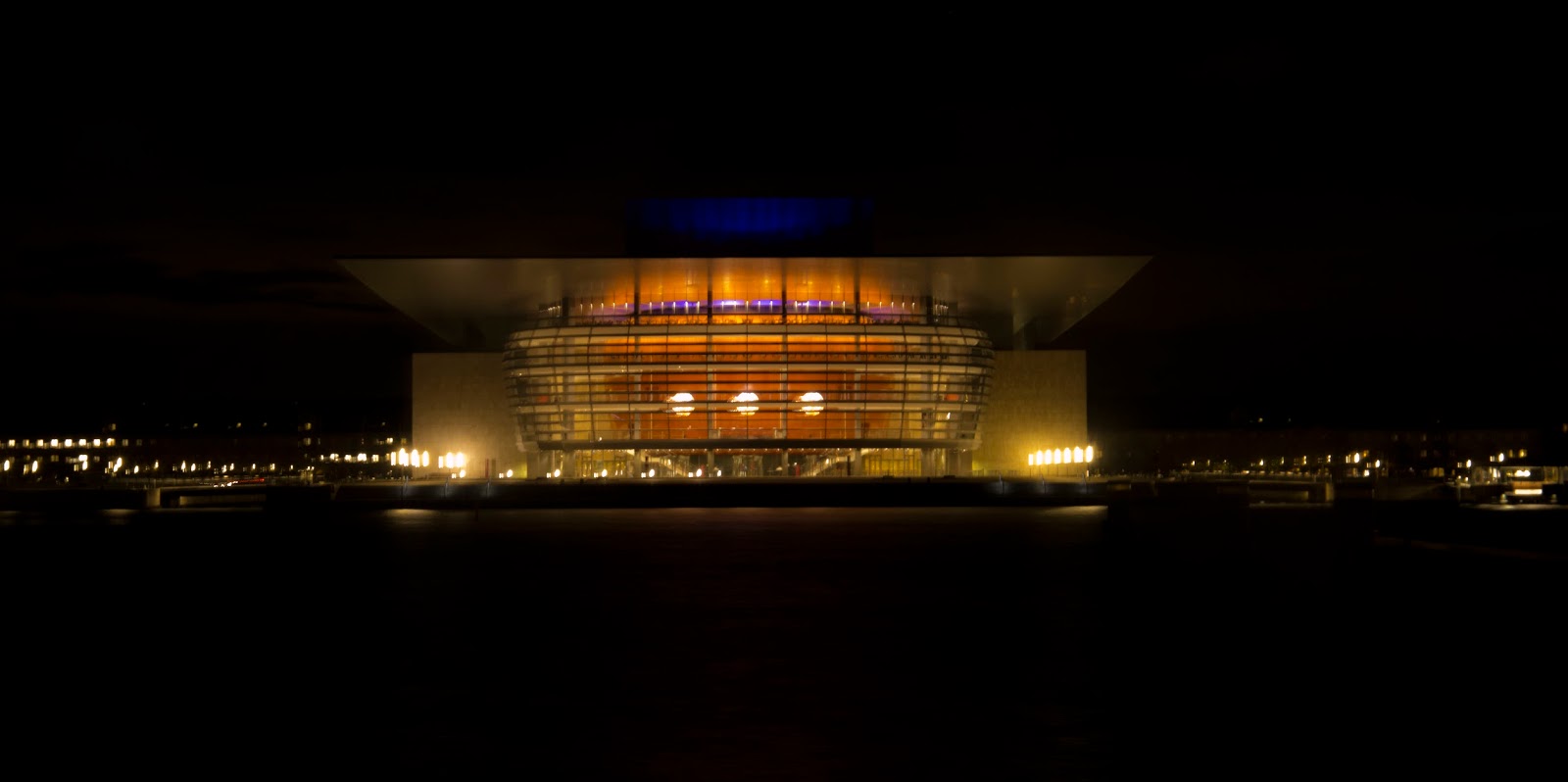
The Copenhagen Opera House at night

Nyhavn Habour. (My favorite part of Copenhagen)


The first fascinating thing about Malmo actually occurred on my way to Malmo. Very strangely on the Danish – Swedish border there was a passport control check but none coming back in the opposite direction the following day. When you think about it, it is quite strange but it is my understanding that there is a similar situation in the USA – Canadian border. There you do not need a passport or visa to pass into Canada but if you want to get back into the USA you do. I am sure there is a logical reason for both situations but on the surface, it is very strange. Malmo is a very charming place with a very interesting history. As recently as 1995 the city had massive social problems like unemployment but in a very short space of time, it’s fortunes have changed greatly. From what my tour guide told me it would seem that the city has had a complete economic turnaround on the same scale and pace as Ireland has due to the actions of the mayor of the city at the time. Which instantly made me see this city as a rag to riches story and one in which I could most certainly relate to and one I’m sure Irish people older than I could relate to even more. Another thing I noticed in Malmo was that the majority or bathrooms are non-gender bathrooms. While this is not some brand new idea it did catch my attention considering they were only brought into my own University In Ireland over the last 6 months or so if I remember right.

Modern Art at Malmo Peer

Malmo Lighthouse


Before you ask, yes I did look for an Ikea but unbelievably I could not find one in Malmo. I was, however, able to find a few H and M’s but nowhere near as many as in Copenhagen which I found to be very funny considering it is a Swedish brand. By a million miles my favorite thing about Malmo was the architecture. Manchester, England is a city that has tried and failed to incorporate new styles of buildings into older and more traditional buildings and designs. But Malmo does it beautifully and a great sense of elegance. It just works and nothing looks out of place. It is a place I would recommend any mayor or architect who wants to modernize and older city to look towards. 


Sankt Petri Church, Malmo

Modern Architecture in the City that I simply fell in love with
 After Scandinavia I did go to Switzerland but to avoid this month’s blog post becoming too long I will mention it next month and about my first few weeks of University in Germany. But both have been interesting experiences, to say the least. So, for now thank you for reading and I hope you enjoyed this post.
Turning Torso. The tallest building in all of Scandinavia


*** photos are intentionally unedited*** So no judging ;)

For edited photos follow me on Instagram. Username Diarmuidgraphy

And to read last's month's post (September 2016) you can chick here 

Monday, October 3, 2016

September 2016: Too many new beginnings to count

September 2016: Too many new beginnings to count

New country, new language, new people, moving out for the first time and leaving everything you know behind. Sounds scary right? Not really. Why do you ask? The answer is simply. I never got the chance to be nervous about the change. This is because I only received my exam results on September 1st and I flew out to start a whole new life 36 hours later. Hardly the best preparation but on the bright side I started this experience in a very positive light. I was desperate to arrive in Germany and arrive bundling through the door is exactly what I did. I was so relieved to get here, the challenge I had taken on really had not hit me yet.


I originally flew into Amsterdam. It was on the train from Amsterdam to Hannover a couple of hours later what I had taken on hit me like Miley Cyrus on a wrecking ball. Despite doing the standard cheesy goodbye Facebook post, it was the very moment I was asked in German to present my train ticket and I had to ask the woman to repeat herself, I quickly realised that I was going to be saying that sentence a lot for the next year. In a somewhat funny turn of events, I have been asked to repeat myself in both German and English many times since my arrival. To the point where at times I have thought to myself, “I can speak English right?” It’s getting a lot better now I am learning to slow down everything I say and making it more obvious what I’m referring too. In many ways, my English has improved as much as my German since I got here because I have to be conscious of the fact the majority of people I am speaking English too are not native speakers. As a language student trying to learn German I realise I needed and still need to make changes to my speech patterns the same way I might expect German native speakers to do for me.

Recent picture from a trip to the North Sea


After a Saturday that only gave me enough time to unpack, my adventure began on Sunday morning. With no internet connection and not knowing anybody in the city the few hours walk that morning was an eerie one. A very strange thing to say about a sunny morning in a beautiful green and vibrant city. Thankfully as I was returning home I met a guy who is staying in the same student accommodation as me as I was walking in the door. In a distinct English accent, he said “English oder Deutsch” (English or German) To say I was panicking before this would be a massive overstatement but to meet somebody so close to home so early was a relief knowing full well that I had left all my friends and family back home and on the other side of an Internet connection. Thankfully along with a few other English people and people from all over the world at this stage he has become one of the many great friends I have made in this home away from home.


The next day my classes started and as an International student, I met many of my fellow International students. Some familiar like Spanish, Polish and French. Others new, for example, people from Mexico and Chile. On that day and the weeks that have followed since I have been looking out for the different stereotypes. Some have turned out to have an element of truth about them. For example, every Spanish or South American guy I have played football with has been very talented and I have noticed that the French are very proud of their own language and that is very nice to see. In reality, I have found the differences very small. Or at least a lot less than I expected. This fact is both comforting yet disappointing.

Comforting because it is our differences that so often have divided humans in the past. For example, skin colour, religion and so on. So to know we are all a lot more alike is a great thing for that reason. It’s sad because if we are all so alike surely some of what makes us different has been lost? There will always be differences but it is a little disheartening when it feels like no matter what country you're from you know who Justin Bieber is. Most of the use eat the same cereals in the morning, we have all seen the same movies… In the same way, every person should have something that makes they special so should cultures. Globalisation, trade, and travel are all great things but I definitely think it’s vital that we don’t let even more smaller cultures and traditions to get swallowed up by bigger and mainstream culture and media.

Sometimes it is very easy to look for differences or similarities where they are not there just so the story we have in our head makes sense. Why? Because it's so much easier than to admitting to ourselves that we were wrong about something. The last month has definitely drilled home that classic lesson, "you can't judge a book by its cover" I mean the fact that I am Irish and I don't like Guinness is something is constant, topic of discussion in my life at this stage. Saying all that, when a stereotype does turn out to be true it is oddly satisfying.


Der Neues Rathaus in Hannover >>>

Hanover as a city is very beautiful. One reason for this is that is the fact it is so green. It is not often one can say after leaving Ireland “I am going to a place every bit as green” Monday to Saturday the place is buzzing with life in the way a capital city and a travel epicentre should. One unfortunate thing I have noticed about Hannover and German cities on a whole is that homeless people and begging is a much bigger problem than in Ireland. It was something I noticed last May, but I do think the problem has lessened since then, simply based on my own observations from walking around. Another difference I have noticed in Germany is one I expected. That is that the public transport is very punctual and professional over here. It’s nowhere near perfect but it’s a lot better than I’m used to. To know that the train or bus will arrive when it should 90% of the time is something I really appreciate. The city is also always buzzing with life. From concerts in the streets, football matches, to beer gardens to events by Der Neues Rathaus or the Maschee Lake. A day at home really does seem like a waste and that you are missing out on something.


While the city itself is amazing often I have found the people working with the public here to be more professional.  From my point of view in a negative way. German workers serving the public for example banks, shopkeepers, and transport workers are a lot more standoffish than their counterparts in Ireland. I have noticed it many times between two Germans also. It goes far beyond the language barrier I face every day as I write this. In Ireland, you will always have a two-minute chat with the shop worker to the point you get to know them a little and a friendship begins. I am looking forward to the day a shopkeeper here in Germany says something to me besides what I owe, my change and whether I would like a bag or not. It’s definitely something I miss and falls into the category of “you don’t know what you have until it’ gone” Saying all that I have found 99% of the German people serving the public I have spoken with to be very friendly and helpful with any questions I have had. They do exactly what you ask of them. Never any more and never any less.


There is so much about this country and its people that I admire but not many things stand out more than the capital city of Berlin. The thing I admire the most about this country was only pointed out to me a couple of weeks ago when I was on a guided tour of Berlin given by Sam Noble an English man. It was the best tour I was ever given. Sam made it very interesting because he connected both Berlin’s future and past with his own journey and more importantly with events currently happening in the world as I write this. One thing Sam pointed out was how great Germany as a whole and Berlin in particular deals with its past and the mistakes they have made, He also mentioned how that past affects the decisions the German government makes toady even so many years after both World Wars. From the rebuilding of Check Point Charlie, the creation of the Jewish Memorial, the preservation of the Berlin Wall and the fascination story behind the Brandenburg Gate, Germany has a constant reminder of its dark past. I am sure or at least very optimistic that Germany will not be repeating some of its mistakes from the past. When I think about some of the cover-ups that have happened elsewhere, Germany most certainly sets the standard with its ability to turn a negative moment from its past into a positive today.


Trip to Germany's capital 

I have learned a lot over the last month about myself, Germany and other cultures. I repeat “new country, new language, new people, moving out for the first time and leaving everything you know behind.” It is exciting to know there is still so much to discover. It is at this moment that I am reminded of the saying “it is better to experience something once, then to read about it a thousand times” While there is so much I do miss about home, there is something special about the experience of travelling that changes your outlook and total approach to everything you do. Even after one month is it blatantly clear to me  I will not be returning home the same person I was when I left, as dramatic as it sounds. It’s my job to make sure that change is a positive one and to encourage everybody to travel as much as they can. 


Thursday, July 21, 2016

What is a Multipotentialite and Why You Might Be One Too

Dear Reader,

I have made a discovery, one that makes my world and hopefully yours make a little more sense. That discovery you ask? It was the moment I realised I was a multipotentialite. A mouthful I know, but that just makes it all the more exciting. A multipotentialite is somebody who has a wider range of interest than the average person and I would argue ambitions too.
This journey started about 3 weeks ago when an Irish man named Nicholas Grundy introduced himself to me and invited me to listen to his TEDx Talk. 

Which I did and soon I realised it was like looking at my future self. Nick is a professional photography now, he’s fluent in German, he is a speaker and also somehow has fitted in the time to see much of the world. These are all interest we have in common, but he also told me he is an engineer and has done time in the army. Looking at Nick I saw my doppelgänger, not in terms of the interest we have in common but rather the amount of them. I found it fascinating.

For the first time in my life, I had met somebody who did not just have a passing interest in so many things but was passionate enough to peruse so many dreams and ambitions just like I try to do every day. Nick’s talk was called “How to become a Jack of all trades and a master of some” Yes “some” rather than the more popularized “none” The talk gave me hope that it can be done and I am not doomed to a life of underachieving because I can’t settle on one thing or rather I get distracted from one passion for another one. Right now it is this topic of the multipotentialite.

From my own experience, I find that people settle on a few set things and that’s it. Have you noticed the same? They become a web designer or an accountant for example and just are happy to do that for the next 30-40 years of their life. They then take up a hobby. For example, the guitar and maybe a sport to top it off. While there is nothing wrong with that and I definitely see the sense in focusing on a few areas and becoming strong in all of them, in recent years I have found that it’s very different for me. 

I hope you the reader have found that thing in your life that keeps you up with excitement at night because you’re just that exhilarated about doing it the next day. If you haven’t I beg you to go out and find it. When people ask me what I’m going to do after college I never really know what to say. Not because I don’t have passions or plans but rather I have too many. I have ambitions to be a professional photographer, I want to be a writer, I want to travel the world, I want to be a career coach for others, I want to work in football, I want to work in a job where I get to use my German and finally I want to follow in the footsteps of people like Brendon Burchard and get involved in “Thought Leadership”. I am open to job title suggestions if you have any? I have learned over the last few weeks I am not alone with this and that I should embrace been a multipotentialite and not settle for anything different.

The term multipotentialite was formed from by an American artist named Emilie Wapnick. I came across her on, you guessed it the Ted Stage where she talks about her experiences as a multipotentialite. Like her I feared that “I was scattered or that I was self-sabotaging, afraid of my own success” Emilie soon after mentions a few people who have many career paths throughout their lives and all I could think about what the late Steve Jobs said to a group of Stanford Graduates as he gave his commencement speech. It went as follows “you can’t connect the dots looking forward; you can only connect the dots looking backwards, so you have to trust that the dots will somehow connect in your future. You have to trust in something – your gut, destiny, life, karma, whatever. Because believing that the dots will connect down the road will give you the confidence to follow your heart even when it leads you off the well worth path and that will make all the difference”

So after the talk I rushed home I wrote down all the things that I enjoy doing and all the main experiences in my life that I feel have made me the person I am today and started literally connecting the dots and trying to figure out how my dots will connect. It was amazing when I really set my mind to it I realised that some of the dots have already connected. 
I realised that the reason I want to get involved in thought leadership and career coaching is because I understand the struggling of been confused about what you want to do with your life. My desire to travel comes from my love of photography and my love of writing comes from enjoying poets like Philip Larkin back in school. Who would have thought that a love of poetry and deciding last minute to do a photography class because it was too late to sign up for anything else would unearth a near-unhealthy obsession with the concept of living abroad and poetry about WW1 would lead to me writing pieces like this? I most certainly did not.

In the world of the internet and globalisation, it is now easier than ever to experience new concepts, ideas and to find things you are passionate about. So why does society demand that we commit to so few things and miss out on so much?

As a multipotentialite, it is easy to become the Jack or Jackie of all trades and master of none and this is the trap I find myself falling into from time to time.

I pressed Nick about how he did it and he gave me advice that in hindsight makes perfect sense. The advice was that to be a jack of all trades and a master of some the key is to focus on one or two of them at a time and become good at them and then gradually move onto another. I often fall into the trap of chasing all my goals every day even if it’s only five minutes and in reality end of half doing everything. I felt if I was not working on something every day I had no hope of ever getting better. The sad truth is we may try and kid ourselves but it is focus not multi-tasking that achieves results in this world. In fact, as a multipotentialite focus is even more vital because you won’t have as much time as others to become better at something so you have to make the time you have count.

At this point, it would be easy to think of been a multipotentialite as a bad thing but I assure you it is not, and that’s a very important lesson for everybody especially those who fall into this category. You have to be the hero of your own story and I believe this is my superpower. But like any superpower it’s about controlling it and not letting your life lose direction. I have already mentioned the negatives but there are also many positives.
The main strengths of this talent and I repeat talent are adaptability and creativity. First of all, creativity is the creation of something new that is useful. New creative ideas come from exposing ourselves to new ways of thinking and beliefs. What you know already is one line while what you don’t know is another and creativity is what happens in between those. Multipotentialite’s are constantly exposing themselves to new things, new people, new hobbies and situations. Because of this we have a far greater chance of creating something new. There are more dots, to connect. To be efficient I will give you an example of creativity while taking about adaptability.

Multipotentialite’s can adapt to any situation because it’s not just something we do because we have to but it’s a part of our very nature. To find new challenges and explore them. Adaptability and variety are great skills to have. As a football fan, I have noticed a shift in the type of footballer we see. 10 - 12 years ago the best players were the specialists. The great goal poachers like Michael Owen, the great tacklers like Roy Keane or an out and out crosser of the ball like David Beckham. But today the best players are the players who can do everything. The best goalkeepers like Manual Neuer are as good with their feet as their outfield teammates, players like Ronaldo who are strong and pacey but still have a bag of tricks and maybe the most obvious example, the player who is about to become the world’s most expensive footballer ever, Paul Pogba.  He is a midfielder who would be a match for any footballer physically, he can pass, he can shoot, he can run all day, and he has more tricks up his sock (yes sock) than a magician.
Did you see the originality of that last paragraph? I dare you to try and find the another article with the words “Paul Pogba” and “multipotentialite” in it. But I guarantee you will be left empty handed. 

Because of globalisation and the internet the world has never been so full of ideas and perspectives. Variety is the way we must tackle ever more complicated problems. The world needs people to think outside the box and to be able to see things in a more tolerant, creative and passionate way. The ideas we have to be one thing when we grow up, or that you defined by what you study or doing right now need to be thrown out this instant.

Kind Regards,

Your faithful Multipotentialite,


Diarmuid  

F.Y.I

Check out Emilie Wapnick's talk here 

Check out Nick's ted talk here 


For a fantastic podcast about the potential of multipotentialite's check out this episode call "So Crazy it Just Might Work" from This American life about a Music techer trying to find a cure for a cancer with th power of music

Monday, May 30, 2016

Why I Support Manchester United

In the world of social media and in particular Twitter it is easier than ever to talk with football fans both local to your area and beyond. This is a fantastic thing. You would be hard pushed to find anybody who does not think the sharing of ideas is a bad thing and that goes far beyond football. But unfortunately this comes with some negatives because poisonous views and beliefs of a few can spread like wildfire. On top of that Twitter and other social media sites  have many keyboard warriors or trolls who take every opportunity to point out other people's mistakes or more to the point for this article mock and ridicule other football fans for not having the popular or as I like to call it “pop opinion” of the day.

The poisonous belief amongst Manchester United fans right now is that the club should win by any means necessary. A view that Michael Carrick recently echoed which disappointed me to say the least. I strongly agree that Louis Van Gaal needed to be sacked, but one thing I greatly respected from the man (even if he did overdo it) was the fact that he stood by what he believed in until the very bitter end.  And while many United fans will have no respect for the Dutchman many of them could learn from the FA Cup winner. He stood by his traditions and if Manchester United want to be truly successful they need to stick with their principles within reason in a sport that is always changing with the times.

This is important because identity is important to every person, business and organisation. Would Apple still be Apple if they stopped making IPhones? Would Twitter be Twitter if they scraped the 140 character limit? I think you get the idea. There are just certain things that make people, businesses and organisations who they are. So in this piece I am going to be talking about the 5 main reasons why I support Manchester United or in other words what I think makes this club special. And because if these things after 15 or so years of supporting the club I still have the passion to be writing this at 3 o clock in the morning and before you ask yourself no it can’t wait till the morning because I’m just that annoyed.

Living in Ireland depending on your family, football may or may not be the first sport you come across. For me it was not. Nobody in my family had any interest in the sport at all. My mother loved Gaelic Games, my father athletics. This was so much the case they often joked that they did not know the difference between a football and a rugby ball. So unlike most who choose a team because of a relative or they live near that team. I had complete control over who I supported and why. So here are my five reasons.

1 Youth
This is by far the most important one to me. Even without having a club, like so many other children I dreamed and wanted to be a professional footballer. Even at that age I remember thinking to myself “how is this going to happen?” Luckily I soon came across a Manchester United game and low and behold there were these two kids playing. Their names? Wayne Rooney and Cristiano Ronaldo. In a split second the connection was made that this club gave young kids like me a chance and like every impatient child I wanted this to happen as quick as possible so “why not these guys” Since then I have learned so much more about this tradition from the days of Sir Alex, Matt Busby and most recently Louis Van Gaal. One of the beliefs that makes this club what it is, is the concept “if you’re good enough your old enough” and to this day I find that inspiring, chasing my own dreams even if they have changed since I was five.  Because of this I will never accept the idea of only buying big expensive players to have success every year. I really would rather see the club finish 1st and 2nd every second year with a balance between youth and big names than come first every year with just big names.

2 Attacking Football
While this is not always possible the general belief of any Manchester United side should be to attack with pace power, width and conviction in order to entertain a crowd who pay more than most. While there is nothing wrong with parking the bus away to Barcelona or when you have a 1-0 lead with five minutes remaining and you’re down to 10 men we as a fan base cannot accept  consistently boring football. Thankfully that was the case this season and because of that Louis Van Gaal departed Old Trafford 12 months too early for some.  There will always be desperate times that call for desperate measures and when the club will do anything to win but for the most part this club plays football and conducts itself in a positive manner that fans can be proud of.

3 Consistency
With the exception of Bayern Munich, few if any football clubs keeps the same players for as long periods of time better than Manchester United. On top of this the Red Devils often keep these players involved with the club in one way or another after they retire. This can vary from a role as a coach like Ryan Giggs or Nicky Butt, or a club ambassador like Ji Sung Park and Sir Bobby Charlton. In the modern game where players and managers are out the door almost as soon as they come in, the continued connection can mean a lot. As a fan you can look at the former player and think “he’s still one of us, he’s still part of the family”  

4 The Irish connection
As mentioned already in this piece I am Irish. Manchester United shares a rich history of Irish men both as players and managers. Whether they were from the Republic or the North. Ireland can boast having some great Manchester United players like George Best, Roy Keane, John O Shea and even today Paddy McNair who will hopefully get more opportunities next season.  So much about been a fan of a club is the special connections that make it stand out from the other. As a foreign fan effectively (realistically I’m across the pond) it is great to have so many connections to the one club. It’s something you simply can’t buy. Living in Cork I have spoken with Roy Keane a couple of times. After you look back on the experience and you realise “I just spoke with the former captain of Manchester freaking United” It’s enticing. This is not a standalone event. It is no coincidence that Manchester United are incredibly popular in Asia after signing players such as Park Ji Sung and Shingi Kagawa.

5 Never say die attitude
First of all, it’s not called “Fergie Time” for nothing. While this is one tradition that has faded in recent years. The never say day attitude around this club is something that one cannot help but admire and want to be part of. That belief in yourself and your team mates to never say die when all seems to be lost was something I grew up with. I always felt that no matter what the score was Manchester United would find a way of winning. I didn’t know how it would happen but I knew that it would. As I was only four I won’t pretend I was screaming with joy in 1999 but there are many games I will never forget. For example when Robin Van Persie scored his first hat trick for the club against Southampton to win 2-3 at Saint Mary’s or that Federico Macheda winner against Aston Villa which produced one of the most well-known pieces of commentary from Martin Tyler. It would be madness to want Manchester United and Jose to be losing 2-0 every week just so we can have some great dramatic wins to look back on but when it does happen I’m going to love every moment of it.


The idea of winning at any cost, makes us just like any other club. This is not just any other club, it is England’s if not the world’s leading club. Like all leaders the club must lead my example and show why it is called the beautiful game.  The idea that winning at all costs is not something I want at mine and yours club. If we wanted a club that bought success we would support Manchester City, if we wanted a club which tolerated players like Pepe we would support Real Madrid and if wanted a club that accepted it was average and lived off its past we would support Liverpool. But that is not the case. This club attacks the opposition and the moment, it gives youth a chance and most importantly it never gives up and does not lose itself in order to achieve success yesterday. The club like everybody else will always need to adapt and change but these basic principle can never change because if they do, it’s just not Manchester United any more. 

Featured Post

Exchange Students: Get the Most Out Of Your Year Abroad

1.    Sort out the essentials before arriving. This may not sound like the most exciting advice in the world, but that makes our first pi...